
August Native Prairie Speaker Series – Webinar
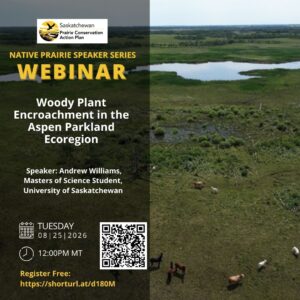
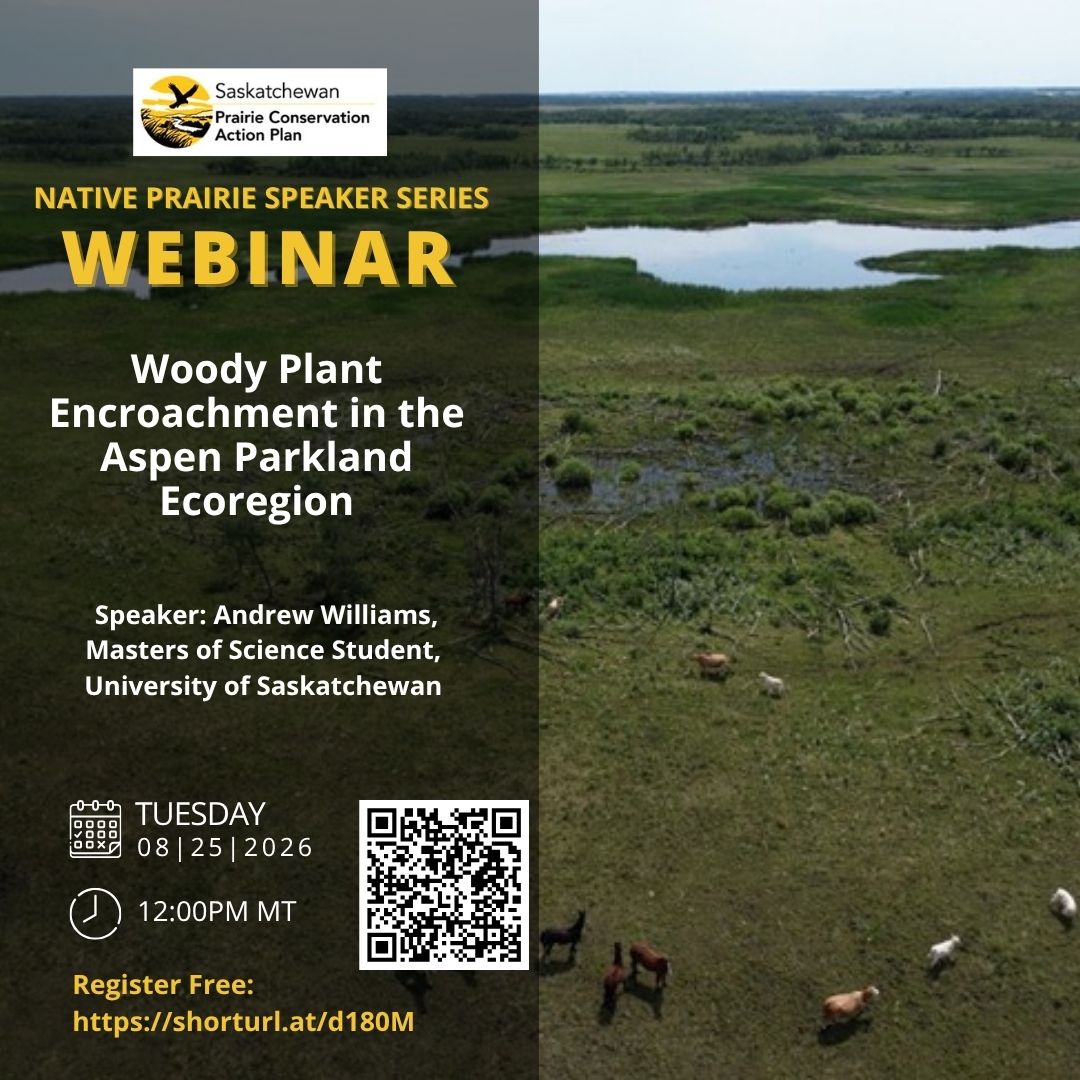
Woody Plant Encroachment in the Aspen Parkland Ecoregion
Speaker: Andrew Williams, Masters of Science Student, University of Saskatchewan
Watch the Recording on our YouTube Channel
More Information about our August Webinar
Hosted by: Caitlin Mroz-Sailer, Stewardship Coordinator, Prairie Conservation Action Plan
Presenting Sponsors: Canadian Forage and Grasslands Association, North American Helium, Pembina, Saskatchewan Cattlemen’s Association and SaskTel
This webinar is in conjunction with Transboundary Grassland Partnership – Webinar, Saskatchewan Edition

About this Webinar:
Woody encroachment is a significant range management issue in western Canada. Here we examine the impact of woody encroachment on forage quality and quantity in the Aspen Parkland ecoregion of Saskatchewan, Canada by estimating the rate of scale of woody plant encroachment over the last 40 years in a representative Aspen Parkland pasture, and by quantifying the effects of increasing woody cover on forage production and quality. Forage production declined with increasing tree cover, with a 10% increase in tree cover resulting in a loss of approximately 80 kg of grass production and 58 kg of forb production per hectare. Shrub cover did not impact forage production, but forage quality declined with increasing shrub cover. The current extent of woody plant cover on the pasture, and changes over time, were estimated using remote sensing methods. Estimates for 2024 using high-resolution (10 m) Sentinel imagery are that 16.93% (7.55 km2) of Foam Lake pasture has tree cover, and an additional 7.87% (3.51 km2) of Foam Lake pasture has shrub cover. Tree cover was estimated from historical Landsat imagery to be 27.07% in 1985, increasing to 32.34% in 2009 and followed by a drop to 18.75% in 2024. While woody cover on this pasture is currently relatively stable, further research is needed to assess longer-term historical trends in cover.